A renowned surgeon, a change management expert, an evaluator of healthcare organizations, and vendor credentialing SMEs walk into an Orlando resort bar…
There’s no joke here. This is just an accurate rundown of the esteemed experts who shared valuable expertise from their respective fields with the healthcare credentialing professionals who attended the 2024 C4UHC Symposium at the Margaritaville Resort in Orlando, Florida in June.
Experts included keynote speaker Dr. Steven McCarus, Chief of the Gynecologic Surgery Division of AdventHealth Winter Park in Orlando, Florida; Cece Berger Sharp, President & COO of The Riverbend Group; and Wayne Murphy, Director, Joint Commission Resources.
“We were so fortunate to welcome these speakers to address different aspects of the sometimes challenging process healthcare facilities encounter in adopting a standardized approach to vendor credentialing,” said Nancy Pakieser, Executive Director, C4UHC.
“C4UHC thanks each of them for sharing their vast knowledge, helping to extend and enhance our discussions on how to best advocate for standardized vendor credentialing in healthcare.”
The dialogue between the speakers and those involved in vendor credentialing on a daily basis uncovered significant opportunities to meet the needs of all stakeholders, especially patients, in a more standardized, compliant, and efficient manner.
Keynote Speaker Dr. Steven McCarus: Non-Standardized Credentialing Can Wreak Havoc In Planning and Performing Surgeries

Dr. Steven McCarus, Chief of the Gynecologic Surgery Division of AdventHealth Winter Park in Orlando, Florida offered conference attendees a physician’s perspective on healthcare vendor credentialing.
As a developer of his own surgical technique (“the McCarus Technique for MIS hysterectomy”), Dr. McCarus is a recognized authority on pelvic minimally invasive procedures. A lecturer and preceptor in high demand, he has traveled to South Africa, Australia, Singapore, Hong Kong, Japan, and throughout the U.S. at the request of institutions who wish to benefit from his live instruction.
His valuable insights confirmed how the current cumbersome credentialing practices at hospitals and other healthcare facilities can negatively impact patient care and safety by creating time-consuming and costly barriers. For example, Dr. McCarus said he personally feels challenged when a medical device supplier sends a less experienced representative who has been in the field only two months. He had also heard of other instances when surgeries had to be deferred or cancelled due to a rep’s inability to be granted access to the procedural area due to a credentialing issue.
This rarely happens at his own facility because of its strong perioperative coordination team, ensuring that any support staff and outside vendors have the proper credentials to support clinical staff effectively.

Renowned physician Dr. Steven McCarus discussed how challenges within current vendor credentialing processes have affected his work as a surgeon and an educator.
Dr. McCarus also explained that he must be credentialed for any facility he works at or any school he visits as a traveling professor. He highlighted that credentialing for physicians and clinicians is largely standardized, bypassing duplicative efforts experienced by other areas of the healthcare system. It’s a seamless process for him, but not for vendor reps.
Dr. McCarus says he sees the benefits of standardizing any healthcare process if it makes it easier to fulfill the number one goal: delivering quality patient care. From the perspective of C4UHC, that is possible with the ANSI Standard.
The Riverbend Group’s Cece Berger Sharp: Learning to Manage Change Within Your Healthcare Organization

It’s human nature to resist change. But change is everywhere, constant, and only picking up speed, according to Cece Berger Sharp, President and COO of The Riverbend Group.
During her presentation to professionals advocating for change in healthcare vendor credentialing practices, Sharp explored the dynamics around change and the issues they often trigger within individuals. Those issues usually become challenges when an organization needs to adapt to shifting conditions or overcome obstacles in order to achieve its growth goals.
A key element of her presentation was “The Change Curve,” which follows people’s emotions and opinions throughout the implementation of a new system. At the beginning, enthusiasm and expectations are high until they are weighed down by inevitable glitches and challenges, sending people into resistance, even when they are excited about the change. But once the hiccups are worked out and exploration of the new system increases, opinions go back up often reaching higher than expected levels. From the perspective of C4UHC and supporting organizations, there is a great deal of potential to heighten levels of expectation and performance through standards and interoperability.

Cece Berger Sharp shared with attendees tools they could use to help manage change within their organizations.
Sharp also led a learning session driven by a workbook that outlined the four stages of change (denial, resistance, exploration, and commitment) and provided tools to help groups manage change together. Attendees left the workshop with a greater understanding of how to view change and how to help others embrace it within many different aspects of life.
Wayne Murphy, Field Director, Joint Commission Resources: How Selection and Evaluation Processes Enhance the Quality of Outside Vendors
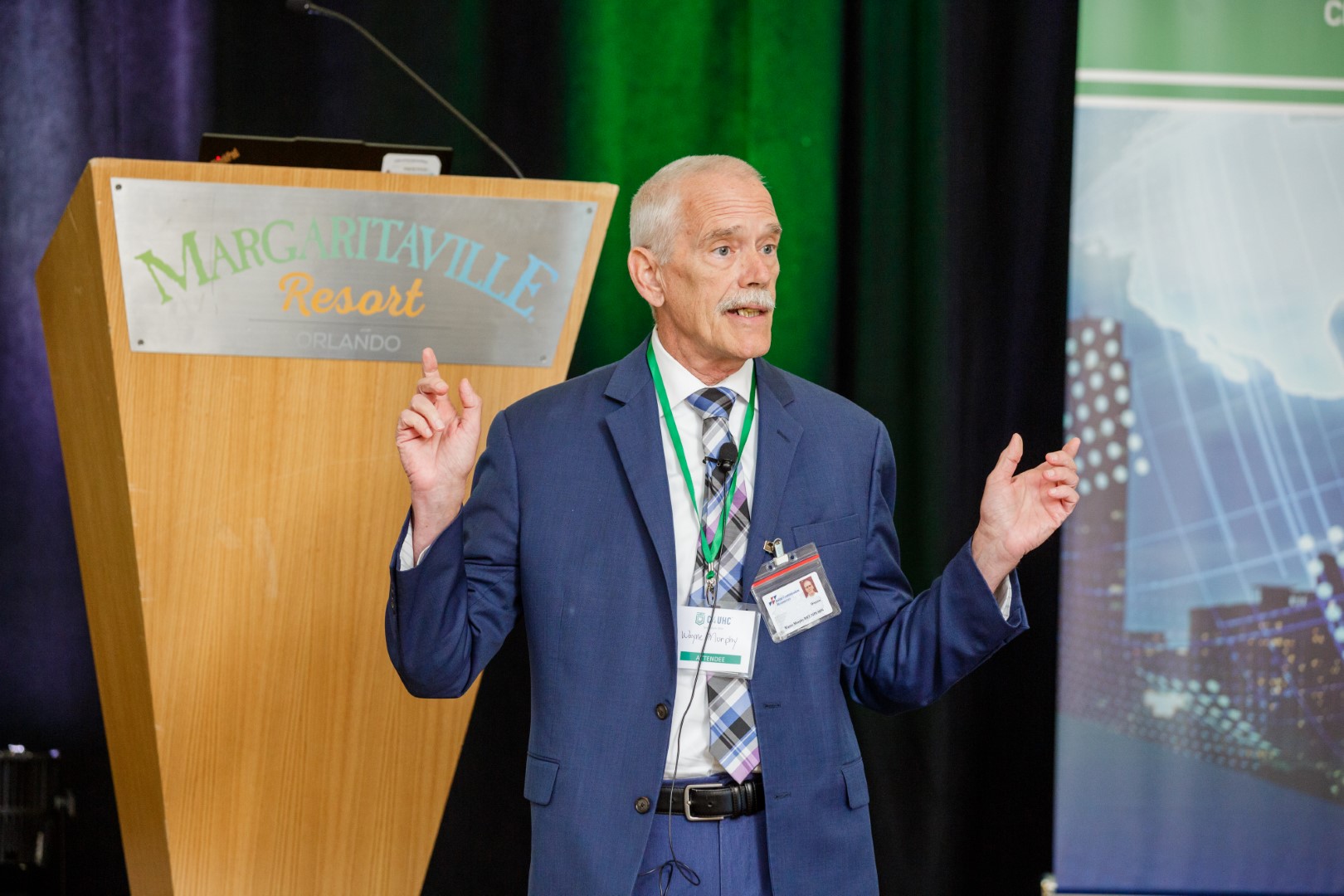
When you want the best and latest information on a rapidly evolving topic such as healthcare vendor credentialing, you go to the top experts. C4UHC did just that by presenting Wayne Murphy of Joint Commission Resources, the official educator and publisher of The Joint Commission, the #1 accrediting body for U.S. healthcare organizations.
Murphy began with a comprehensive overview of the current healthcare industry, ranging from the financial impact of mergers to issues around supply chains, and data security and privacy. He later emphasized the importance of the selection and evaluation processes in identifying outside vendors who can deliver quality products and services. While The Joint Commission does not recommend specific vendor credentialing standards, it evaluates a healthcare system’s process already in place and then validates that the facility is following its chosen procedures.
Moving deeper into vendor credentialing topics, Murphy shined a light on current healthcare vendor trends, including examples of new services and technologies being offered by vendors such as:
- Telemedicine and virtual care platforms
- Data analytics and AI (generative)
- Patient engagement technologies such as mobile apps/portals
- Remote monitoring services
- Active supply procurement and delivery

Wayne Murphy of The Joint Commission Resources outlined the current trends and challenges in vendor credentialing for healthcare facilities.
He also discussed the impact of vendor trends on healthcare organizations, including how risks for vendors can cause risks to facilities, and how C-suites and boards are now demanding hard evidence that compliance risks are being managed. In addition, Murphy noted several present challenges in the healthcare credentialing space, including how the Centers for Medicare & Medicaid Services (CMS) expect boards to evaluate all vendors, as well as the question of who keeps the collected data in cases of 3rd party verification processes. This topic created a large discussion related to vendor documentation, resulting in the determination that as long as the documents can be provided to TJC auditors within a timely fashion, source documents do not need to be physically “on site.” It was suggested it would be valuable for health systems to document this process within their hospital policies and indicate that the individual or employer is ultimately responsible for these documents.
Murphy’s valuable insights also included some of the questions that often arise when The Joint Commission is evaluating an organization’s vendor credentialing procedures, including the current hot topic of tiered access: Does a facility have a vendor credentialing program for “lower risk” individuals who access non-patient care areas? How does the credentialing audit for an organization’s healthcare personnel differ from vendor requirements? Suggested guidance on requirements for the different levels of non-employees can be found in C4UHC’s Non-employee Access Tier Decision Matrix.
“We were pleased to be able to set the bar high for ourselves in welcoming such esteemed professionals to our event,” said Nancy Pakieser, Executive Director, C4UHC. “C4UHC has a tremendous foundation to build upon as we plan for next year’s symposium speakers.”
Please contact us to learn how you can join C4UHC’s mission to standardize healthcare vendor credentialing.


C4UHC Symposium 2024 Speakers Offer Diversity of Insights and Expertise on Healthcare Vendor Credentialing
A renowned surgeon, a change management expert, an evaluator of healthcare organizations, and vendor credentialing SMEs walk into an Orlando resort bar…
There’s no joke here. This is just an accurate rundown of the esteemed experts who shared valuable expertise from their respective fields with the healthcare credentialing professionals who attended the 2024 C4UHC Symposium at the Margaritaville Resort in Orlando, Florida in June.
Experts included keynote speaker Dr. Steven McCarus, Chief of the Gynecologic Surgery Division of AdventHealth Winter Park in Orlando, Florida; Cece Berger Sharp, President & COO of The Riverbend Group; and Wayne Murphy, Director, Joint Commission Resources.
“We were so fortunate to welcome these speakers to address different aspects of the sometimes challenging process healthcare facilities encounter in adopting a standardized approach to vendor credentialing,” said Nancy Pakieser, Executive Director, C4UHC.
“C4UHC thanks each of them for sharing their vast knowledge, helping to extend and enhance our discussions on how to best advocate for standardized vendor credentialing in healthcare.”
The dialogue between the speakers and those involved in vendor credentialing on a daily basis uncovered significant opportunities to meet the needs of all stakeholders, especially patients, in a more standardized, compliant, and efficient manner.
Keynote Speaker Dr. Steven McCarus: Non-Standardized Credentialing Can Wreak Havoc In Planning and Performing Surgeries
Dr. Steven McCarus, Chief of the Gynecologic Surgery Division of AdventHealth Winter Park in Orlando, Florida offered conference attendees a physician’s perspective on healthcare vendor credentialing.
As a developer of his own surgical technique (“the McCarus Technique for MIS hysterectomy”), Dr. McCarus is a recognized authority on pelvic minimally invasive procedures. A lecturer and preceptor in high demand, he has traveled to South Africa, Australia, Singapore, Hong Kong, Japan, and throughout the U.S. at the request of institutions who wish to benefit from his live instruction.
His valuable insights confirmed how the current cumbersome credentialing practices at hospitals and other healthcare facilities can negatively impact patient care and safety by creating time-consuming and costly barriers. For example, Dr. McCarus said he personally feels challenged when a medical device supplier sends a less experienced representative who has been in the field only two months. He had also heard of other instances when surgeries had to be deferred or cancelled due to a rep’s inability to be granted access to the procedural area due to a credentialing issue.
This rarely happens at his own facility because of its strong perioperative coordination team, ensuring that any support staff and outside vendors have the proper credentials to support clinical staff effectively.
Renowned physician Dr. Steven McCarus discussed how challenges within current vendor credentialing processes have affected his work as a surgeon and an educator.
Dr. McCarus also explained that he must be credentialed for any facility he works at or any school he visits as a traveling professor. He highlighted that credentialing for physicians and clinicians is largely standardized, bypassing duplicative efforts experienced by other areas of the healthcare system. It’s a seamless process for him, but not for vendor reps.
Dr. McCarus says he sees the benefits of standardizing any healthcare process if it makes it easier to fulfill the number one goal: delivering quality patient care. From the perspective of C4UHC, that is possible with the ANSI Standard.
The Riverbend Group’s Cece Berger Sharp: Learning to Manage Change Within Your Healthcare Organization
It’s human nature to resist change. But change is everywhere, constant, and only picking up speed, according to Cece Berger Sharp, President and COO of The Riverbend Group.
During her presentation to professionals advocating for change in healthcare vendor credentialing practices, Sharp explored the dynamics around change and the issues they often trigger within individuals. Those issues usually become challenges when an organization needs to adapt to shifting conditions or overcome obstacles in order to achieve its growth goals.
A key element of her presentation was “The Change Curve,” which follows people’s emotions and opinions throughout the implementation of a new system. At the beginning, enthusiasm and expectations are high until they are weighed down by inevitable glitches and challenges, sending people into resistance, even when they are excited about the change. But once the hiccups are worked out and exploration of the new system increases, opinions go back up often reaching higher than expected levels. From the perspective of C4UHC and supporting organizations, there is a great deal of potential to heighten levels of expectation and performance through standards and interoperability.
Cece Berger Sharp shared with attendees tools they could use to help manage change within their organizations.
Sharp also led a learning session driven by a workbook that outlined the four stages of change (denial, resistance, exploration, and commitment) and provided tools to help groups manage change together. Attendees left the workshop with a greater understanding of how to view change and how to help others embrace it within many different aspects of life.
Wayne Murphy, Field Director, Joint Commission Resources: How Selection and Evaluation Processes Enhance the Quality of Outside Vendors
When you want the best and latest information on a rapidly evolving topic such as healthcare vendor credentialing, you go to the top experts. C4UHC did just that by presenting Wayne Murphy of Joint Commission Resources, the official educator and publisher of The Joint Commission, the #1 accrediting body for U.S. healthcare organizations.
Murphy began with a comprehensive overview of the current healthcare industry, ranging from the financial impact of mergers to issues around supply chains, and data security and privacy. He later emphasized the importance of the selection and evaluation processes in identifying outside vendors who can deliver quality products and services. While The Joint Commission does not recommend specific vendor credentialing standards, it evaluates a healthcare system’s process already in place and then validates that the facility is following its chosen procedures.
Moving deeper into vendor credentialing topics, Murphy shined a light on current healthcare vendor trends, including examples of new services and technologies being offered by vendors such as:
Wayne Murphy of The Joint Commission Resources outlined the current trends and challenges in vendor credentialing for healthcare facilities.
He also discussed the impact of vendor trends on healthcare organizations, including how risks for vendors can cause risks to facilities, and how C-suites and boards are now demanding hard evidence that compliance risks are being managed. In addition, Murphy noted several present challenges in the healthcare credentialing space, including how the Centers for Medicare & Medicaid Services (CMS) expect boards to evaluate all vendors, as well as the question of who keeps the collected data in cases of 3rd party verification processes. This topic created a large discussion related to vendor documentation, resulting in the determination that as long as the documents can be provided to TJC auditors within a timely fashion, source documents do not need to be physically “on site.” It was suggested it would be valuable for health systems to document this process within their hospital policies and indicate that the individual or employer is ultimately responsible for these documents.
Murphy’s valuable insights also included some of the questions that often arise when The Joint Commission is evaluating an organization’s vendor credentialing procedures, including the current hot topic of tiered access: Does a facility have a vendor credentialing program for “lower risk” individuals who access non-patient care areas? How does the credentialing audit for an organization’s healthcare personnel differ from vendor requirements? Suggested guidance on requirements for the different levels of non-employees can be found in C4UHC’s Non-employee Access Tier Decision Matrix.
“We were pleased to be able to set the bar high for ourselves in welcoming such esteemed professionals to our event,” said Nancy Pakieser, Executive Director, C4UHC. “C4UHC has a tremendous foundation to build upon as we plan for next year’s symposium speakers.”
Please contact us to learn how you can join C4UHC’s mission to standardize healthcare vendor credentialing.